How Law Firms Can Stop Losing Revenue from Missed Calls
Executive Summary
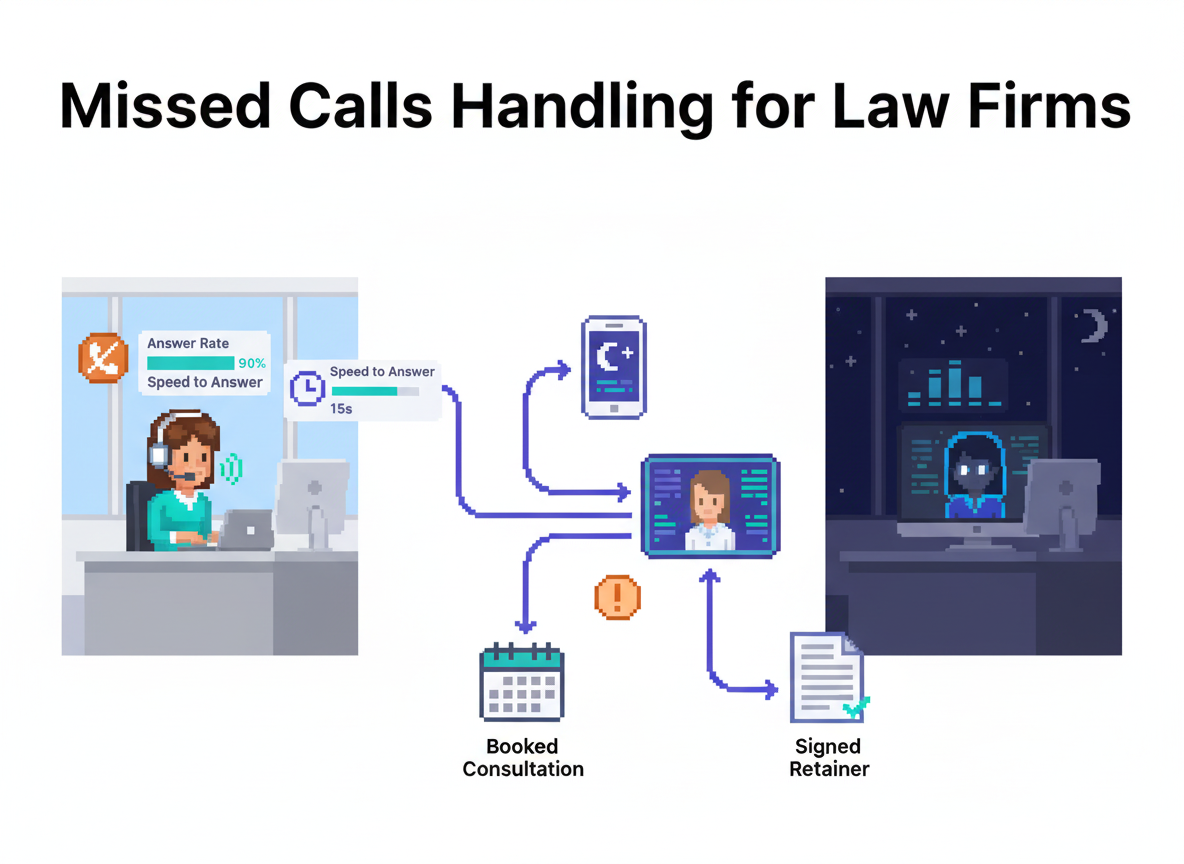
Every unanswered intake call is a potential client—and potential revenue—lost. For law firms competing in fast-moving practice areas, the cost of missed calls compounds quickly: prospects move on, marketing dollars are wasted, and staff time is diverted to manual callbacks that rarely convert. This guide shows firm owners and operations leaders how to plug those leaks. You’ll learn the coverage models that raise answer rates, the intake processes that improve qualification and booking, the technology that speeds response, and the metrics that prove impact. Where exact industry statistics vary, we use ranges or clearly labeled examples so you can adapt the model to your practice.
What Problem Are We Solving?
- Missed or delayed responses to first-time inquiries
- Inconsistent intake process, leading to low booked-consultation rates
- Lack of visibility into call performance (answer rate, abandonment, speed to answer)
- After-hours and peak-hour gaps that cost high-intent prospects
The Outcome We’re Aiming For
- High answer rate during business hours and after-hours
- Fast average speed to answer measured in seconds, not minutes
- Reliable overflow coverage for peaks
- Structured qualification + scheduling during the first interaction
- Instrumented metrics and dashboards in your CRM/phone system
Why Law Firms Miss Calls
- Limited coverage windows: Phones ring only 9–5, with no after-hours or weekend plan.
- Peak-hour bottlenecks: A handful of staff try to handle intake, existing client calls, and internal admin simultaneously.
- No overflow: When lines are busy, new callers hit voicemail or abandon.
- Unclear ownership: Intake falls between receptionist, paralegal, and attorneys, so accountability is fuzzy.
- Tools not tuned: IVR trees too long, no call-back automation, no voicemail-to-text, or no routing by practice line.
The Economics of Missed Intake Calls
Consider a simple example for a consumer-facing practice:
- Monthly inbound first-time inquiries: 400
- Average fee per retained matter: $3,000–$7,500 (varies widely by practice)
- Signed-retainer rate from booked consults: 25%–45%
If 20%–30% of first-time calls aren’t answered live and only a portion of those callers return, you can easily forfeit five figures per month in potential fees. Even modest improvements—raising answer rate, shortening time-to-callback, and booking more consults on the first call—produce outsized gains.
What Good Looks Like: Practical Targets
Exact benchmarks vary by market and practice, but many efficient firms aim for:
- Answer rate: 90%+ during business hours; 80%+ overall with after-hours coverage
- Average speed to answer (ASA): under 20–30 seconds during business hours
- Abandonment rate: under 5% during business hours; under 10% overall
- Booked consultation rate: 35%–55% of qualified inquiries
- First-contact resolution: Intake completes qualification and books consult in one interaction whenever possible
Coverage Models That Raise Answer Rate
1. Business-Hours Coverage with Queues and Skills
- Route new inquiries to a dedicated “intake” queue separate from existing client lines.
- Use skills-based routing (e.g., Spanish line, practice-area line).
- Set ASA targets and alert when queues back up.
2. Overflow Coverage for Peak Hours
- When the queue exceeds X calls or ASA exceeds Y seconds, overflow to a trained team or a legal answering service.
- Ensure the overflow partner can book directly to your calendar and follow your qualification script.
3. After-Hours and Weekend Coverage
- Provide 24/7 coverage through an answering service trained on legal intake, or through an internal on-call rotation.
- Offer immediate booking of “next available” consults; for emergencies (e.g., criminal defense), escalate via on-call workflows.
4. Emergency and VIP Handling
- Define urgent categories (e.g., custody orders, arrests, severe injury) with immediate escalation paths.
- Maintain limited VIP slots daily/weekly to accommodate high-value, time-sensitive matters.
People and Process: Make Intake a Function, Not an Accident
- Ownership: Assign an Intake Lead responsible for training, QA, and weekly KPI reviews.
- Scripts and decision trees: Create concise scripts that verify conflicts, collect essentials, and book consults.
- Qualification: Define “qualified” vs “unqualified” clearly; route non-matches to referral partners to preserve goodwill.
- Scheduling: Let intake book directly into attorney calendars with guardrails (buffer times, consult types, video or phone links).
- Follow-up protocols:
- If call is missed: automated text acknowledging the attempt + callback link within minutes.
- If voicemail is left: transcription to intake queue + SLA to respond within 15 minutes during business hours and within 1 hour after-hours.
- If consult not booked: schedule a follow-up text/email within 24 hours.
Technology Stack for Law Firm Call Management
- Phone system/CCaaS: Queueing, skills routing, ASA/abandonment metrics, and call recording.
- Legal answering service: Trained team that follows your script, books in your calendar, and updates your CRM.
- CRM and intake forms: Capture caller details once; avoid double entry.
- Calendar integration: Real-time availability; distinct consult types and durations.
- Automated callbacks and SMS: Trigger immediate outreach when a call is missed.
- Voicemail-to-text: Fast triage and prioritization.
- Tracking numbers: Attribute marketing sources (PPC, LSAs, billboards) to calls.
- Analytics: Dashboards for answer rate, abandonment, ASA, booked consults, and conversion to retained.
Metrics That Matter
Answer Rate
Formula: answered calls / total inbound calls
Example: 360 answered out of 420 inbound = 85.7% answer rate
Average Speed to Answer (ASA)
Measured in seconds from ring to pickup within your queues. Target ranges: 20–30 seconds during business hours.
Abandonment Rate
Formula: callers who hang up before answer / total inbound calls
Example: 18 abandons out of 420 inbound = 4.3% abandonment
Booked Consultation Rate
Formula: booked consults / qualified inquiries
Example: 120 booked out of 260 qualified = 46.2%
No-Show Rate
Formula: missed consults / booked consults
Track and reduce with reminders, confirmations, and rescheduling links.
Cost per Booked Consultation
Formula: total marketing + intake cost / booked consults
Use tracking numbers and CRM attribution to calculate accurately.
Conversion to Retained
Formula: signed retainers / consults held
Monitor by channel to prioritize the highest-quality sources.
Putting It Together: A Simple ROI Model
Suppose:
- 400 inbound inquiries/month
- 80% answer rate today (320 answered), 20% missed (80 missed)
- 40% of missed inquiries call back or are reached by follow-up (32 recovered)
- 45% booked-consult rate on answered or recovered inquiries, and 35% retain from consults
If you raise answer rate from 80% to 92% with overflow + after-hours, you answer 368 calls (+48). At the same downstream rates, that might yield roughly 7–10 additional signed matters per month depending on mix and pricing. Exact results vary, but the sensitivity is clear: small changes in answer rate and speed to answer compound through the funnel.
90-Day Rollout Plan
Days 1–14: Instrument and Stabilize
- Turn on call tracking, ASA, and abandonment dashboards by line and by hour of day.
- Separate intake queue from existing client lines; add skills routing for practice lines.
- Draft intake scripts and qualification criteria; stand up same-day callback automation for missed calls.
Days 15–30: Add Coverage
- Implement overflow rules (threshold on queue length or ASA) to an internal team or legal answering service.
- Launch after-hours coverage with booking capability into attorney calendars.
- Define emergency escalation and on-call schedules.
Days 31–60: Optimize Conversion
- Train intake on scripts, objection handling, and consult scheduling.
- Add voicemail-to-text and SMS follow-ups.
- A/B test consult types (15 vs 30 minutes; phone vs video) and booking windows.
Days 61–90: Prove Impact and Standardize
- Review weekly KPIs with Intake Lead; target variances by hour and practice line.
- Build a simple intake QA rubric (3–5 calls per rep per week) with coaching notes.
- Document SOPs and handoffs; finalize dashboards for owner/ops review.
Hypothetical Case Examples
Criminal Defense Shop, Urban Market
- Before: 75% answer rate; sporadic after-hours coverage; ASA ~60 seconds; consult bookings mostly manual callbacks.
- After adding 24/7 answering + overflow: 92% overall answer rate; ASA ~25 seconds; same-day booking from calls; meaningful lift in signed retainers.
PI Firm, Mixed Media Spend
- Before: Multiple marketing numbers but no unified routing; peak-hour abandonment spikes; no-show issues for consults.
- After: Skills-based routing by campaign, overflow at ASA > 30s, reminder workflows; improved booked consults and lower no-show rate.
Compliance, Privacy, and Professionalism
- Conflicts checks: Verify conflicts before collecting sensitive details.
- Advertising rules: Ensure scripts align with your jurisdiction’s professional responsibility rules.
- Data handling: Secure call recordings, transcripts, and SMS under your privacy policy; control vendor access.
- Accessibility: Offer TTY/TDD or relay services where appropriate.
Common Pitfalls to Avoid
- Treating intake as a “reception duty” instead of a core revenue function
- Overengineering IVR: Long menus increase abandonment
- Not giving overflow access to calendars, forcing manual callbacks
- Ignoring hourly patterns: Lunch peaks and late afternoon spikes often need targeted coverage
- Reporting only totals: Look at answer rate and ASA by hour and by practice line
Quick Intake Checklist
- Dedicated intake queue with clear ownership
- Overflow and after-hours coverage with booking rights
- Script + decision tree + qualification criteria
- Calendar integration with protected consult slots
- Missed-call automation (text + callback link) and voicemail-to-text
- Dashboards: answer rate, ASA, abandonment, booked consults, conversion to retained
- Weekly intake QA and coaching
FAQ
Q: Do I need 24/7 in-house staff? Not typically. Many firms pair business-hours internal intake with a legal answering service for after-hours, weekends, and overflow.
Q: Won’t an IVR annoy callers? Keep menus short (one level) and route quickly to intake. The goal is to get high-intent callers to a human fast.
Q: How fast is “fast enough” for callbacks? Aim for minutes, not hours. Automated texts + one-click callback scheduling helps you respond while intent is highest.
Q: What if attorneys resist calendar access? Protect blocks for consults, define rules, and let intake book within those windows. The gain in conversion typically outweighs the occasional calendar friction.
Conclusion and Next Steps
Missed calls are a preventable source of revenue leakage. By treating intake as a core function, adding overflow and after-hours coverage, and instrumenting a handful of metrics, most firms can improve both client experience and top-line results within a quarter. Start by measuring answer rate and ASA this week, add a simple overflow rule next week, and iterate from there.
If you’d like help implementing intake coverage and analytics, book a 30-minute working session to map your current call flows, identify quick wins, and outline a 90-day plan tailored to your practice.